Every command has two parts
Almost every drill command comes in two pieces. The preparatory command tells you what movement is coming and gets you ready. The command of execution tells you exactly when to do it. The trick is not to move on the preparatory command. You wait for the snap.
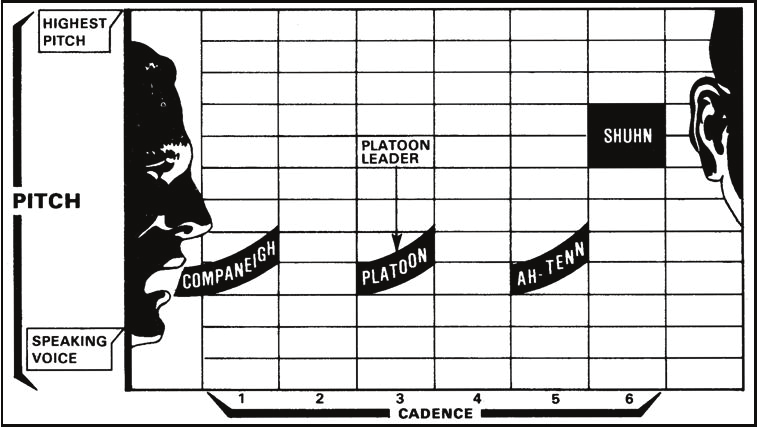
- PREP “For-ward,” stated and drawn out, rising in pitch. It alerts you.
- EXEC “MARCH,” sharp and snapped out. You step off on this word, not before.
Put together it is “FOR-ward, MARCH.” In Army manuals the command of execution is printed in bold capitals and the preparatory command in bold italics, so you can see the beat on the page. A few commands are combined into one part with no pause: FALL IN, AT EASE, REST, FALL OUT. And if a leader needs to cancel a command before the execution word, the call is AS YOU WERE.
It is worth seeing what that actually sounds like. The Army diagrams a command as pitch against cadence: the preparatory command rises above your speaking voice and stretches across several counts, then the command of execution lands hard and short on one. That shape is why a good command carries across a field and a flat one does not.
Position of Attention
The command is “Squad, AH-TENN-SHUN.” Heels together at a 45-degree angle, legs straight but knees not locked, body erect, arms hanging naturally with thumbs along the trouser seams, head and eyes to the front. Stay silent and still. The one fault that bites people: locking the knees, which makes Soldiers faint in a long formation.
From attention you will learn the rest positions: Parade Rest (left foot ten inches out, hands behind the back), Stand at Ease (parade rest, but head and eyes track the person in charge), At Ease (keep the right foot planted, relax but stay quiet), and Rest (right foot planted, but you may move and talk quietly).
The hand salute
As a drill movement the salute is a crisp two-count: up in one motion, down in one. The mechanics live in the drill manual; the rules for when to salute are in customs and courtesies.
The squad, your first formation
You will spend your first weeks as one Soldier in a squad. Knowing where you stand, how the squad forms, and how it faces and dresses right is most of what early drill is about.
Common mistakes, and how to practice
Almost every early error is one of these four. Fix them before you get to Reception and you will look like you have done this before.
- JUMP Moving on the preparatory command instead of the command of execution. Nothing happens until the second word. On Right, FACE, you hold until FACE.
- EARLY Anticipating the command and moving before it lands. Wait for it, then move sharp. Early is as wrong as late.
- SLACK A loose position of attention. Eyes forward, no talking, no looking around, still. And do not lock your knees, that is how people go down in a long formation.
- SALUTE A sloppy salute. Fingertip to the brow, forearm at the right angle, and you hold it until it is returned. Too early or dropped too soon reads as unsure.
You can drill all of this at home for free. Practice the facing movements and the hand salute in front of a mirror, and say the two-part commands out loud until the cadence is automatic. That is the whole point: when your body already knows the movement, the first morning feels familiar instead of foreign.
Where it comes from
Standardized drill in the U.S. Army traces to Baron von Steuben, who began teaching it at Valley Forge in 1778. His manual, nicknamed the Blue Book, stayed in use for 85 years, and terms you will hear on the drill pad still come straight out of it.
Why this matters before you sign
You are not expected to march clean before basic. But if you already know that you hold until the command of execution, and you can hold attention without locking your knees, your first day on the drill pad is a review instead of a scramble.
SOURCES: TC 3-21.5, DRILL AND CEREMONIES (JAN 2012, MAY 2021 CHANGE) · FIGURE FROM TC 3-21.5, DISTRIBUTION STATEMENT “APPROVED FOR PUBLIC RELEASE; DISTRIBUTION IS UNLIMITED” · CURRENT AS OF PULSE CHECK DATE